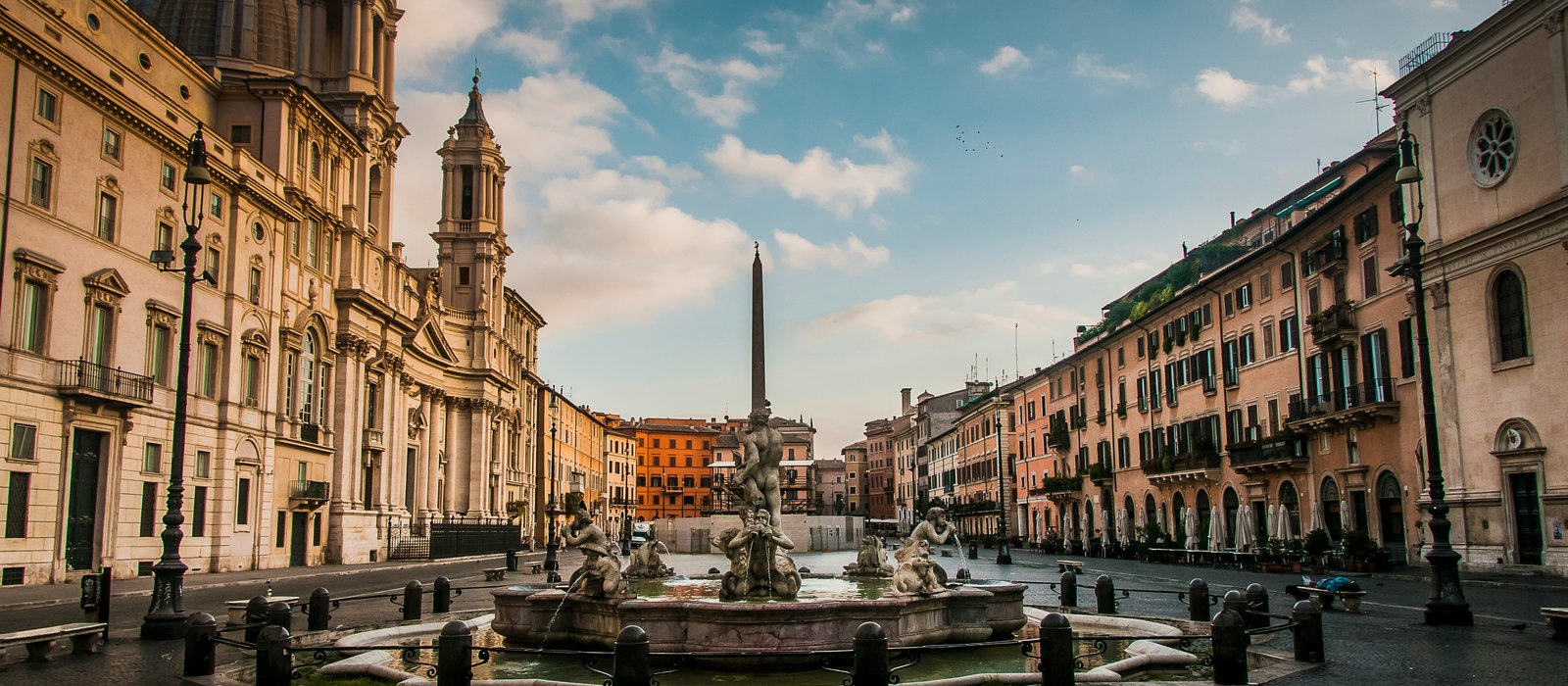
Piazza Navona is Rome's most beautiful Baroque square — a long, elegant oval lined with palaces and churches, animated by three fountains and the open-air bustle of cafés, artists, and street performers. Its distinctive shape is no accident: you're standing inside the footprint of an ancient Roman stadium. For all its fame it's easy to walk through Navona without noticing what makes it special, so this guide walks you through it step by step — the history under your feet, the fountains to find, and how to enjoy the square without falling into its tourist traps.
Why the square is shaped like a racetrack
Start with the ground plan, because it's the key to everything. Piazza Navona sits directly on top of the Stadium of Domitian, an ancient Roman arena built around 80 AD for athletic competitions (its Greek-style footraces gave the area its name). The stadium held tens of thousands of spectators, and the medieval and Renaissance city simply built over and around its oval track — which is why the piazza is a long, rounded rectangle rather than a typical square, and why the buildings curve to follow the ancient stands. You can still visit the excavated ruins of the stadium beneath the piazza's north end (a small museum), seeing the original arches several meters below today's street level. Knowing this transforms the square from "pretty oval" into "two-thousand-year-old arena."
The three fountains
Navona's centerpiece is its trio of fountains, and the middle one is a masterpiece:
Fountain of the Four Rivers (Fontana dei Quattro Fiumi)
The dramatic centerpiece, designed by Gian Lorenzo Bernini (1651). Four muscular figures represent the great rivers of four continents then known — the Nile (head veiled, because its source was unknown), the Ganges, the Danube, and the Río de la Plata — around a rocky base topped by an Egyptian obelisk. It's one of Bernini's supreme achievements, full of dynamism and hidden symbolism. (A popular legend says one figure recoils in disdain from the nearby church façade by Bernini's rival Borromini — charming, though the timeline doesn't quite support it.)
Fountain of the Moor (Fontana del Moro)
At the south end, a figure wrestling a dolphin, surrounded by tritons — also touched by Bernini.
Fountain of Neptune (Fontana del Nettuno)
At the north end, Neptune battling a sea monster, with sea nymphs — the trio's later completion, balancing the Moor.
The great rivalry on display
Piazza Navona is the best place in Rome to feel the famous rivalry between the two titans of the Baroque: Gian Lorenzo Bernini and Francesco Borromini. The two geniuses competed for the era's greatest commissions and could hardly have been more different — Bernini the charismatic, theatrical showman who dominated papal Rome, Borromini the brilliant, tormented architect of daring, mathematically inventive forms. In this one square they face off directly: Bernini's exuberant Fountain of the Four Rivers sits right in front of Borromini's church, Sant'Agnese in Agone, with its dramatic concave façade. The legend that Bernini's Río de la Plata figure throws up a hand in horror at Borromini's church — or that the veiled Nile "can't bear to look" at it — is almost certainly a later invention (Bernini's fountain was finished before Borromini took over the church façade), but it captures a real artistic enmity, and it makes the square a kind of frozen duel between the two men who built Baroque Rome. Standing between the fountain and the church, you're standing in the middle of their rivalry.