Few squares capture Rome's split personality like Campo de' Fiori. By morning it's a centuries-old open-air market, all fruit, flowers, and produce under canvas awnings; by night it's one of the city's liveliest social hubs, the stalls cleared away for crowds spilling out of bars and restaurants. Brooding over it all is the hooded bronze statue of a philosopher burned at the stake on this very spot. It's a square with a dark history and an irrepressible energy, right in the heart of the historic center. Here's how to experience both its faces — and avoid its traps.
The square's two lives
The name means "field of flowers," a nod to the meadow that stood here before the square was laid out in the 15th century. What makes Campo de' Fiori special is its dramatic daily transformation:
- By day: one of Rome's oldest and most famous open-air markets, running every morning except Sunday (roughly 7/8 a.m. to early afternoon). Stalls sell produce, flowers, spices, pasta, and increasingly tourist souvenirs — it's the last historic market square in the centro, and a lively, colorful spectacle even if you're just browsing.
- By night: once the stalls clear, the square becomes a nightlife hub, ringed by bars, restaurants, and crowds, buzzing late into the evening with locals, students, and visitors.
Watching the square shift from market bustle to evening buzz — or simply choosing which version suits your mood — is the whole experience.
Giordano Bruno: the dark history
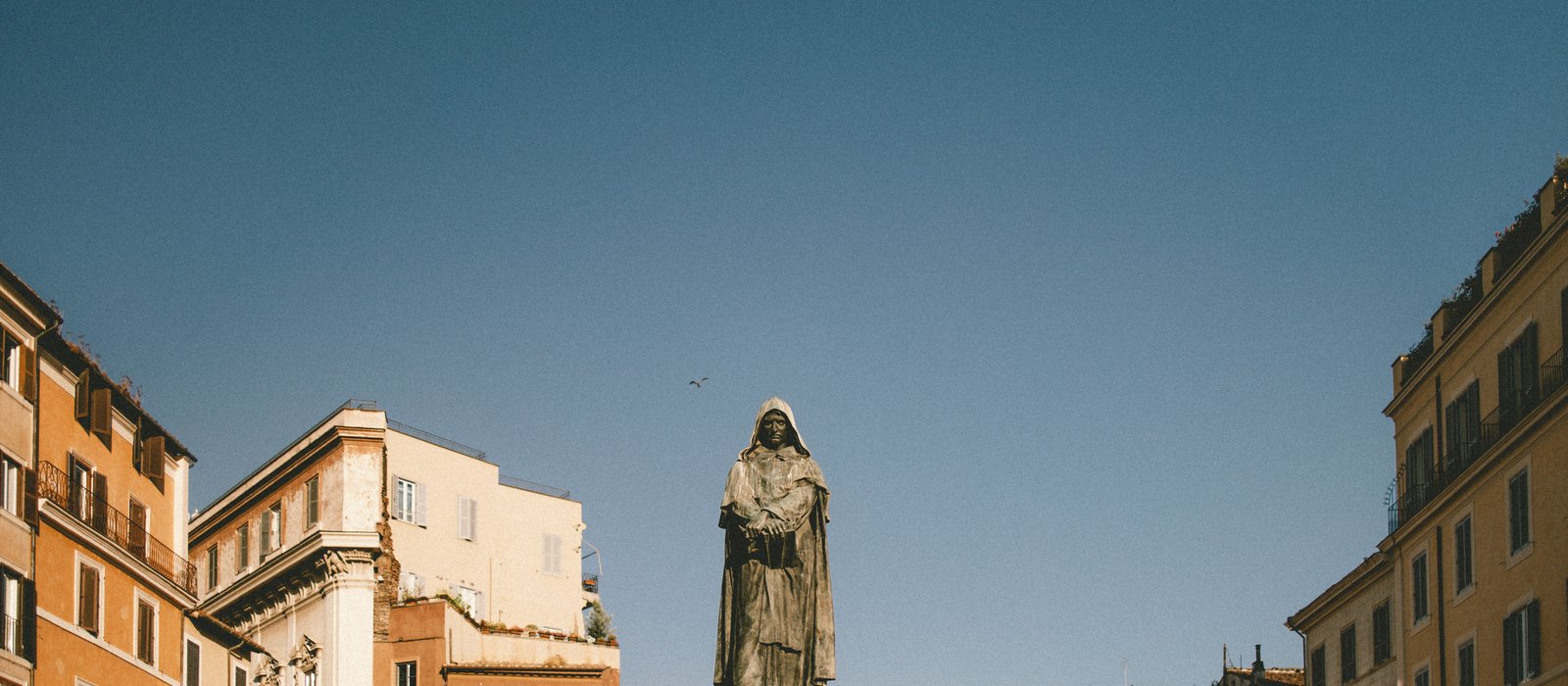
At the center stands the brooding statue of Giordano Bruno, a philosopher and friar who was burned at the stake here for heresy in 1600, condemned by the Church partly for arguing the universe was infinite and the Earth orbited the sun. The statue, erected in 1889 as a monument to free thought, deliberately faces toward the Vatican — a posthumous gesture of defiance. Campo de' Fiori was for centuries a site of public executions, and that darker past gives the cheerful market square an undercurrent of history worth pausing on. The statue is also a longstanding gathering point for cultural and political demonstrations.
What to do
- Browse the morning market — go reasonably early (before it winds down in the early afternoon) for the liveliest atmosphere; it's great for photos, a snack, or picking up fruit.
- People-watch over a coffee or aperitivo — the square is prime people-watching, day or night.
- Use it as a base for the centro — Campo de' Fiori sits between Piazza Navona, the Pantheon, and the Jewish Ghetto, making it a natural hub for exploring on foot.
- Explore the side streets — the lanes radiating off the square (toward Piazza Farnese, with its grand palazzo, and beyond) hold better, more authentic bars and trattorias than the square itself.
- See Piazza Farnese next door — a more elegant, calmer square with the magnificent Palazzo Farnese (the French Embassy) and twin fountains.
What's nearby (and why the location is the point)
Part of Campo de' Fiori's value is simply where it sits — at the crossroads of some of the centro's best corners, all within a few minutes' walk, which is why it works so well as a hub. Right next door is Piazza Farnese, a complete contrast: calm, elegant, and grand, dominated by the magnificent Renaissance Palazzo Farnese (now the French Embassy, with interiors by Michelangelo and others) and a pair of handsome fountains — a serene antidote if the Campo's bustle gets to be too much. A short stroll one way brings you to Piazza Navona and the Pantheon; another way leads across to the Jewish Ghetto and the Tiber, with Trastevere just over the river. The lanes immediately around the square — toward Via Giulia, one of Rome's most beautiful Renaissance streets — are full of antique shops, artisan workshops, wine bars, and trattorias far better than anything on the square itself. In other words, Campo de' Fiori is less a destination to linger at for hours than a brilliantly located pivot point: see the square and market, then spin off in any direction into some of the richest territory in the historic center.
Avoiding the traps
Campo de' Fiori's popularity is also its weakness, so a few honest warnings:
- The bars and restaurants directly on the square are largely tourist traps — overpriced, often mediocre. For a drink or meal, head a few steps into the side streets for better quality and value (a recurring Rome rule).
- The market has gone touristy — it's still atmospheric, but expect souvenir stalls alongside the produce; it's more a lively scene to enjoy than a place locals do their serious shopping now.
- Nights get rowdy — the square is a party spot, fun if that's what you want, but not the place for a quiet dinner (and worth knowing if you're staying nearby — it's loud late).
- Mind petty theft in the evening crowds, as anywhere busy in Rome.
How it fits into a day
Campo de' Fiori is best as a stop within a historic-center wander rather than a destination in itself — it takes 20–30 minutes to enjoy the square and market, longer if you settle in for a coffee or a meal. Pair it with Piazza Navona and the Pantheon (a few minutes away), or cross toward the Jewish Ghetto. Come in the morning for the market, or in the evening for the buzz — or both, to see the square's two souls.
The bottom line
Campo de' Fiori is Rome's square of two faces — a centuries-old morning market that becomes a buzzing nightlife hub after dark, presided over by the defiant statue of Giordano Bruno and his grim history. Enjoy the market early, people-watch over an aperitivo, and use it as a base for the centro — but eat and drink on the side streets, not the tourist-trap perimeter. Catch it by day, by night, or both, and you'll see one of the most characterful corners of old Rome.
Keep planning
Not sure how it all fits together?
Pick your trip length and we'll route a real day-by-day plan.
Build your trip →