Here's one of Rome's best-kept secrets for art lovers: some of the greatest paintings ever made hang not in ticketed museums but in ordinary working churches, where you can walk in off the street and see them for free. Caravaggio — the revolutionary Baroque master of light and shadow, whose violent, dramatic realism changed Western painting — left a remarkable number of masterpieces in Rome, many of them still in the very chapels they were painted for. This guide maps where to find them, which are free, and how to see the lot in a single brilliant walk through the historic center.
Why see Caravaggio in situ
There's something uniquely powerful about seeing a Caravaggio where it was meant to be seen — in the dim side-chapel of a church, emerging from darkness exactly as the artist intended, rather than under museum lights. His signature chiaroscuro (extreme contrast of light and dark) was designed for these shadowy spaces, and his radical realism — saints with dirty feet, ordinary faces, raw emotion — was meant to confront ordinary worshippers. Seeing the work in context, for free, is one of the most moving art experiences in Rome, and one most visitors walk right past.
The three free churches (the essential trio)
All three are in the historic center, within a short walk of each other and of the Pantheon and Piazza Navona — you can see all of them in one easy loop.
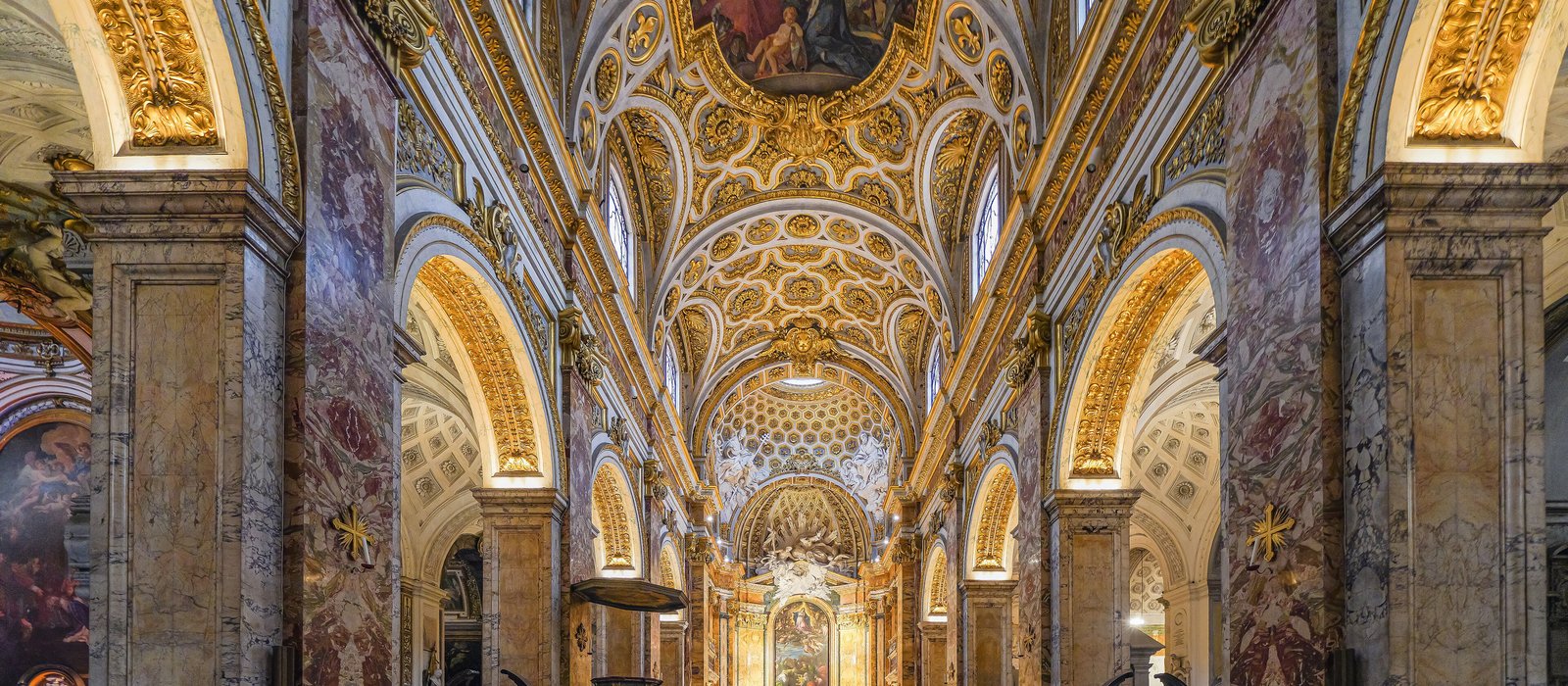
San Luigi dei Francesi
The crown jewel. In the Contarelli Chapel hangs the complete St. Matthew cycle — three paintings: The Calling of St. Matthew (the famous shaft of light), The Inspiration of St. Matthew, and The Martyrdom of St. Matthew. Between the Pantheon and Piazza Navona, free to enter. This is the must-see.
Santa Maria del Popolo
At Piazza del Popolo, the Cerasi Chapel holds two dramatic masterpieces: The Crucifixion of St. Peter and The Conversion of St. Paul (Saul falling from his horse in a blaze of light). Free, and the church itself is full of other treasures (including Raphael's Chigi Chapel).
Sant'Agostino
Near Piazza Navona, this church holds the Madonna dei Pellegrini (Madonna of the Pilgrims) — controversial in its day for depicting the Virgin as an ordinary woman and the pilgrims with dirty, road-worn feet. Free, and often blissfully quiet.
Why Caravaggio still stuns
It helps to know a little about the man to feel the full force of the paintings. Michelangelo Merisi da Caravaggio (1571–1610) was a revolutionary and a scandal — a brawling, hot-tempered genius who lived a turbulent life in Rome, fled the city after killing a man, and died young on the run. His art was as radical as his life: he painted directly from live models, including ordinary people off the street, gave his saints and Madonnas dirt under their fingernails and weariness in their faces, and used dramatic, theatrical light slicing out of deep darkness to freeze a moment of intense emotion. To his contemporaries this was shocking — sacred subjects rendered with brutal, unidealized realism — and some of his altarpieces were initially rejected for being too raw. Today that same realism and drama is exactly why he feels so startlingly modern, almost cinematic, four centuries on. Standing in a dim chapel as a coin-fed light suddenly reveals The Calling of St. Matthew — the beam of light, the pointing hand, the everyday faces around the table — you're seeing the moment Western painting changed.