If there's one thing Rome does better than almost anywhere, it's the piazza — the public square as the beating heart of city life. Some are world-famous, thronged with visitors; others are quiet local secrets where you'll share the space with Romans and pigeons. Together they're the city's open-air living rooms, and seeking them out is one of the great free pleasures of a Rome trip. This is a guide to the most beautiful piazzas worth your time — the icons you shouldn't miss, and the lesser-known squares that reward a detour.
The famous ones (deservedly)
These are busy for a reason — don't skip them, just time them well (early or late beats midday crowds).
Piazza Navona
Rome's most beautiful Baroque square, an elegant oval built on an ancient stadium, centered on Bernini's Fountain of the Four Rivers. The quintessential Roman piazza (see our dedicated guide).
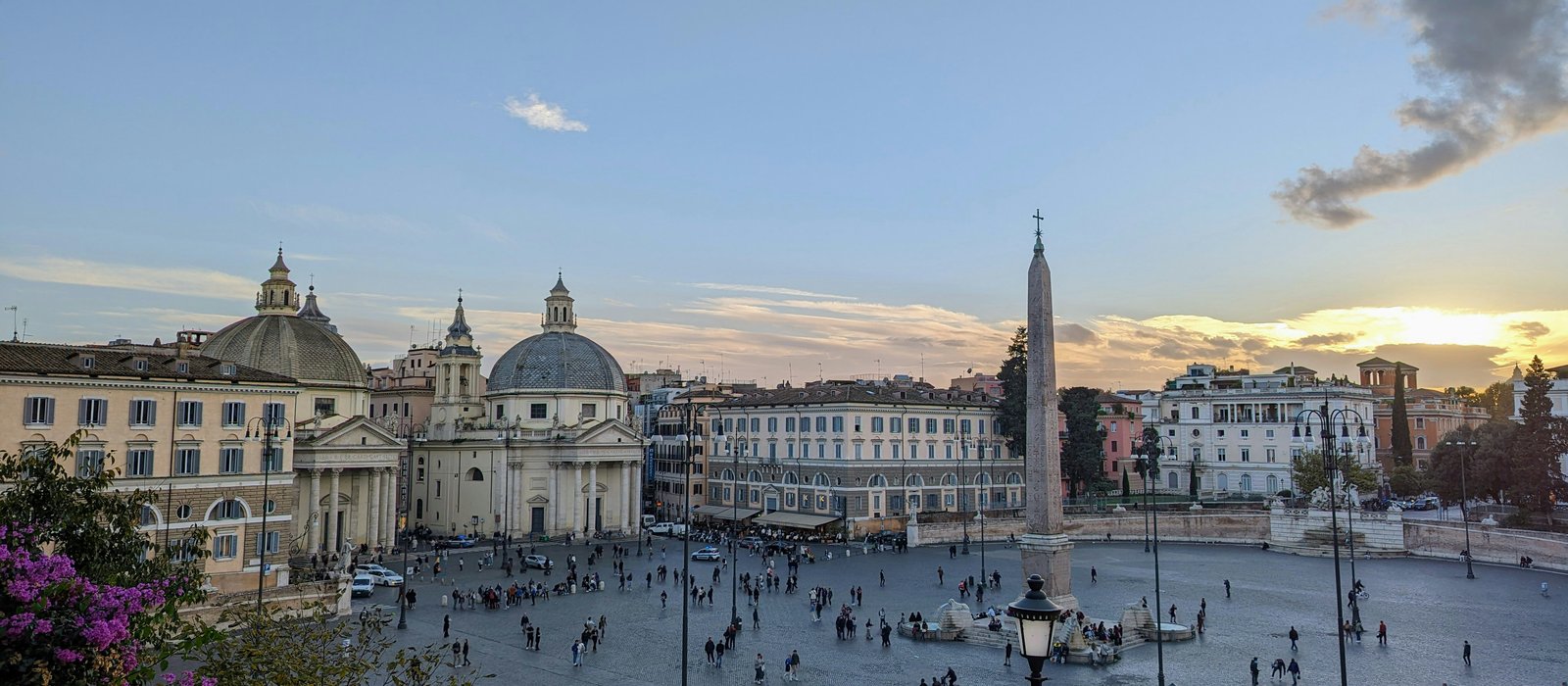
Piazza del Popolo
A vast, dramatic oval at the northern edge of the historic center, framed by twin churches, an ancient Egyptian obelisk at its center, and grand symmetry all around. Climb to the Pincio Terrace above it for one of Rome's best free views over the square and the city's domes.
Piazza di Spagna
The elegant square at the foot of the Spanish Steps, with the Barcaccia fountain and luxury shopping streets fanning off it (see our Spanish Steps guide).
Piazza della Rotonda
The square in front of the Pantheon — you step out of the ancient temple straight into a lively piazza with a fountain and obelisk. Tourist-priced cafés, but an unbeatable view of the Pantheon's portico.
What makes a Roman piazza special
It's worth pausing on why Rome's squares are so good, because it helps you appreciate them beyond the photo. A great Roman piazza is an outdoor room — enclosed enough by surrounding buildings to feel intimate and contained, yet open enough to breathe, usually anchored by a focal point (a fountain, an obelisk, a church façade, a statue) that gives the eye somewhere to rest. Many sit on ancient foundations (Navona on a stadium, others on Roman streets and temples), so they layer two thousand years into one space. And crucially, they're alive — not museum pieces but working public living rooms where Romans meet, children play, vendors sell, and the evening passeggiata unfolds. The Baroque popes understood this deeply, commissioning Bernini and his peers to turn squares into theatrical set-pieces of fountains and façades designed to stop you in your tracks. So when a Roman piazza feels somehow right — proportioned, animated, anchored — that's centuries of deliberate design and continuous public life working on you at once. Learning to simply sit in one and absorb it is one of the city's quiet skills.
The local favorites (seek these out)
These reward you with atmosphere and far fewer crowds — the Rome that feels lived-in.
Piazza del Campidoglio
Michelangelo's sublime square atop the Capitoline Hill, with its star-patterned pavement and the Marcus Aurelius statue — a Renaissance masterpiece of design, and a free overlook of the Forum nearby (see our Capitoline guides).
Piazza Farnese
Just steps from busy Campo de' Fiori but a world calmer — an elegant, dignified square dominated by the magnificent Palazzo Farnese (the French Embassy) and twin fountains. The serene counterpoint to its rowdy neighbor.
Piazza di Santa Maria in Trastevere
The heart of Trastevere, with its golden-mosaic church and an octagonal fountain where locals and visitors gather, especially lovely in the evening (see our Trastevere guides).
Piazza Mattei (and the Turtle Fountain)
A tiny, easy-to-miss square in the Jewish Ghetto holding the exquisite Fontana delle Tartarughe (Turtle Fountain), one of Rome's most charming Renaissance fountains — a perfect hidden-gem detour.
Campo de' Fiori
Market by day, nightlife by night, presided over by the brooding statue of Giordano Bruno — characterful and lively rather than serene (see our dedicated guide).
A few more worth a detour
- Piazza Venezia — not beautiful so much as monumental, dominated by the vast white Vittoriano; the busy hub at the city's center.
- Piazza Sant'Ignazio — a delightful little Rococo square laid out like a stage set, in front of a church with a famous trompe-l'œil ceiling.
- Piazza della Minerva — beside the Pantheon, with Bernini's beloved little elephant-and-obelisk sculpture.
- The Aventine and its Orange Garden — not a piazza but a serene hilltop with the famous keyhole view of St. Peter's dome.
How to enjoy Rome's piazzas
- Time the famous ones for early morning or evening to dodge crowds.
- Sit with a coffee — even at tourist prices, lingering in a great piazza with an espresso is one of Rome's best-value pleasures (you're paying for the seat and the view).
- Go in the evening for the passeggiata — the Italian ritual stroll, when piazzas fill with locals and life.
- Seek out the quiet ones — the local-favorite squares give you Rome without the crush, often just a block from the famous ones.
- They're free — piazza-hopping is one of the best no-cost ways to experience the city.
- Bring the kids or just people-watch — piazzas are where Roman public life happens, from children chasing pigeons to evening crowds; they're as much theater as architecture.
- Pair famous with quiet — visit an icon (Navona, Spagna) then duck to its nearby hidden counterpart (Farnese, the Turtle Fountain square) to feel both faces of Rome within minutes.
The bottom line
Rome's piazzas are its open-air soul, and the best mix the famous with the hidden: don't miss Navona, Popolo, Spagna, and the Pantheon's square, but seek out the quieter gems — Michelangelo's Campidoglio, serene Piazza Farnese, Trastevere's lamplit heart, and the tiny Turtle Fountain square. Time the busy ones for early or late, linger with a coffee, stroll them in the evening passeggiata, and let the local-favorite squares show you the lived-in city. Piazza-hopping costs nothing and delivers some of Rome's most lasting memories.
Keep planning
Not sure how it all fits together?
Pick your trip length and we'll route a real day-by-day plan.
Build your trip →