Perched atop the Capitoline Hill in a piazza designed by Michelangelo, the Capitoline Museums (Musei Capitolini) hold a claim no other museum on earth can match: founded in 1471, they are the oldest public museums in the world. Inside is a stunning concentration of ancient Roman and Greek sculpture — many of the iconic images you've seen reproduced everywhere — plus a fine picture gallery and one of the best free-feeling views over the Roman Forum. For anyone interested in ancient Rome, this is the richest, most rewarding museum in the city. Here's what to see and how to visit.
Why the Capitoline Museums matter
The story begins in 1471, when Pope Sixtus IV donated a collection of ancient bronzes to the people of Rome and placed them on the Capitoline Hill — the sacred heart of ancient Rome since antiquity. That act of making art public is why these are considered the world's first museums. Over the centuries the collection grew into a treasury of antiquities, housed in two palaces (Palazzo dei Conservatori and Palazzo Nuovo) facing each other across Michelangelo's Piazza del Campidoglio, linked by an underground passage. So you're visiting not just a great collection but the very birthplace of the public museum, in one of Rome's most beautiful squares.
The masterpieces to find
The Capitoline holds an extraordinary number of "you've-seen-this-everywhere" works:
- The Capitoline Wolf (Lupa Capitolina) — the iconic bronze she-wolf suckling Romulus and Remus, the very symbol of Rome.
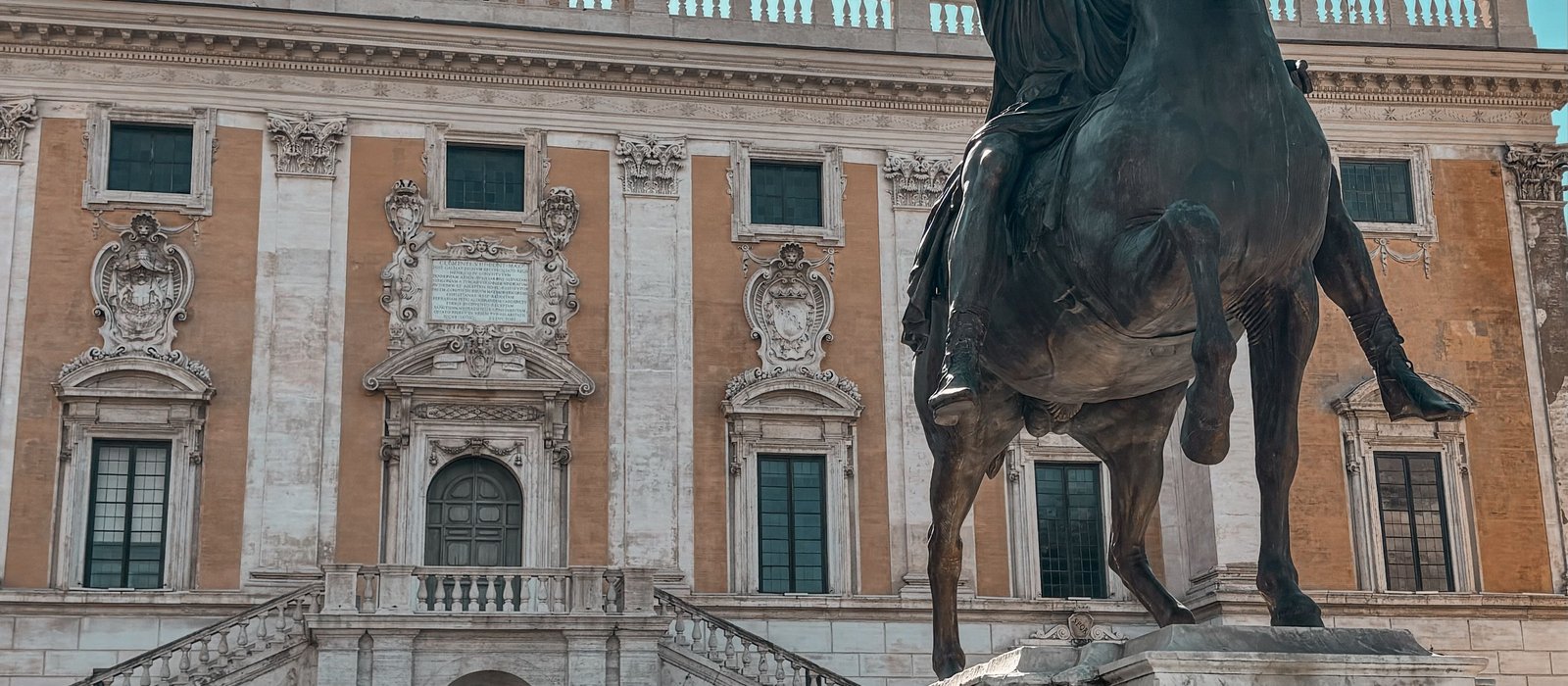
- The equestrian statue of Marcus Aurelius — the original 2nd-century bronze (the one in the piazza outside is a replica), the only surviving bronze equestrian statue of a Roman emperor.
- The Dying Gaul — the poignant, hugely influential sculpture of a fallen warrior.
- The Capitoline Venus — a beautiful Roman copy of a Greek original.
- The colossal fragments of Constantine — the giant marble head, hand, and foot from a vast statue of the emperor, displayed in a courtyard (an unmissable photo).
- The Esquiline Venus, the Boy with Thorn (Spinario), and rooms of busts of emperors and philosophers.
The picture gallery (Pinacoteca)
Upstairs is a painting collection that surprises many visitors, with works by Caravaggio (including John the Baptist and The Fortune Teller), Titian, Rubens, and others — a worthy bonus to the ancient sculpture.
Don't miss the view
A highlight that's easy to overlook: from the Tabularium, the ancient Roman records-office gallery within the museums, you get a spectacular elevated view over the Roman Forum — arguably the best overview of the Forum anywhere, framed by ancient arches. Even if you've walked the Forum, seeing it laid out from above here is a revelation, and it ties the museum's antiquities to the ruins below.
The building and the square
The Capitoline Museums aren't only about what's inside — the setting is part of the masterpiece. In the 1530s, Michelangelo was commissioned to redesign the entire Capitoline Hill, and the result is the Piazza del Campidoglio: a perfectly proportioned square with a swirling geometric star pattern in the pavement, framed by three palaces, two of which (Palazzo dei Conservatori and Palazzo Nuovo) house the museums. He designed the gentle stepped ramp (the Cordonata) that leads up to it and reoriented the whole hill to face St. Peter's rather than the ancient Forum — a symbolic turn from imperial to papal Rome. At the center of the square stands the equestrian Marcus Aurelius (a replica; the original bronze is safely inside the museum). So before you even buy a ticket, you're standing in one of the most influential urban designs in history. The two main palaces are connected underground via the Tabularium gallery, so you move between them — and past that great Forum view — without going back outside.
How to visit
- Location: atop the Capitoline Hill at Piazza del Campidoglio, reached by Michelangelo's gentle stepped ramp (the Cordonata) — a short walk from Piazza Venezia and the Forum (see our Capitoline Hill guide for the surrounding area).
- Tickets: buy on-site or online (check current prices); generally less crowded and less ticket-stress than the Vatican or Borghese, so advance booking is helpful but not always essential.
- Time needed: allow about two hours for a good visit, more if you linger in the picture gallery.
- Combine it with the adjacent Capitoline Hill, the Vittoriano next door, and the Forum just below — they form a natural cluster (see our guides).
Practical tips
- First Sunday of the month is free at state and civic museums like this — great value, but busiest then.
- Check closing days/hours before you go.
- Pace it within an ancient-Rome day — pairing the Capitoline Museums with the Forum and Palatine makes for a deep, satisfying day of antiquity (just don't rush all three).
- The café terrace (Caffarelli terrace) has another lovely view over the city's rooftops — a nice break.
- It's less overwhelming than the Vatican — a manageable, rewarding museum rather than an endurance test, which makes it a great choice if Vatican fatigue is a worry.
- Go in the late afternoon for softer light on the piazza and the Forum view, and to pair the visit with sunset over the rooftops from the terrace.
- Look down as well as up — the museum's lower levels and the Tabularium incorporate actual ancient Roman structures, so you're walking through antiquity, not just looking at it in cases.
The bottom line
The Capitoline Museums are the world's oldest, and for ancient Rome they're the city's most rewarding: the Capitoline Wolf, the original Marcus Aurelius, the Dying Gaul, the colossal Constantine fragments, and a surprising Caravaggio-rich picture gallery, all atop Michelangelo's sublime Campidoglio with the best elevated view over the Forum. Less crowded and less overwhelming than the headline museums, it's the perfect deep-dive for anyone who fell for ancient Rome — allow two hours, pair it with the Forum and the hill, and don't miss the Tabularium's Forum panorama.
Keep planning
Not sure how it all fits together?
Pick your trip length and we'll route a real day-by-day plan.
Build your trip →