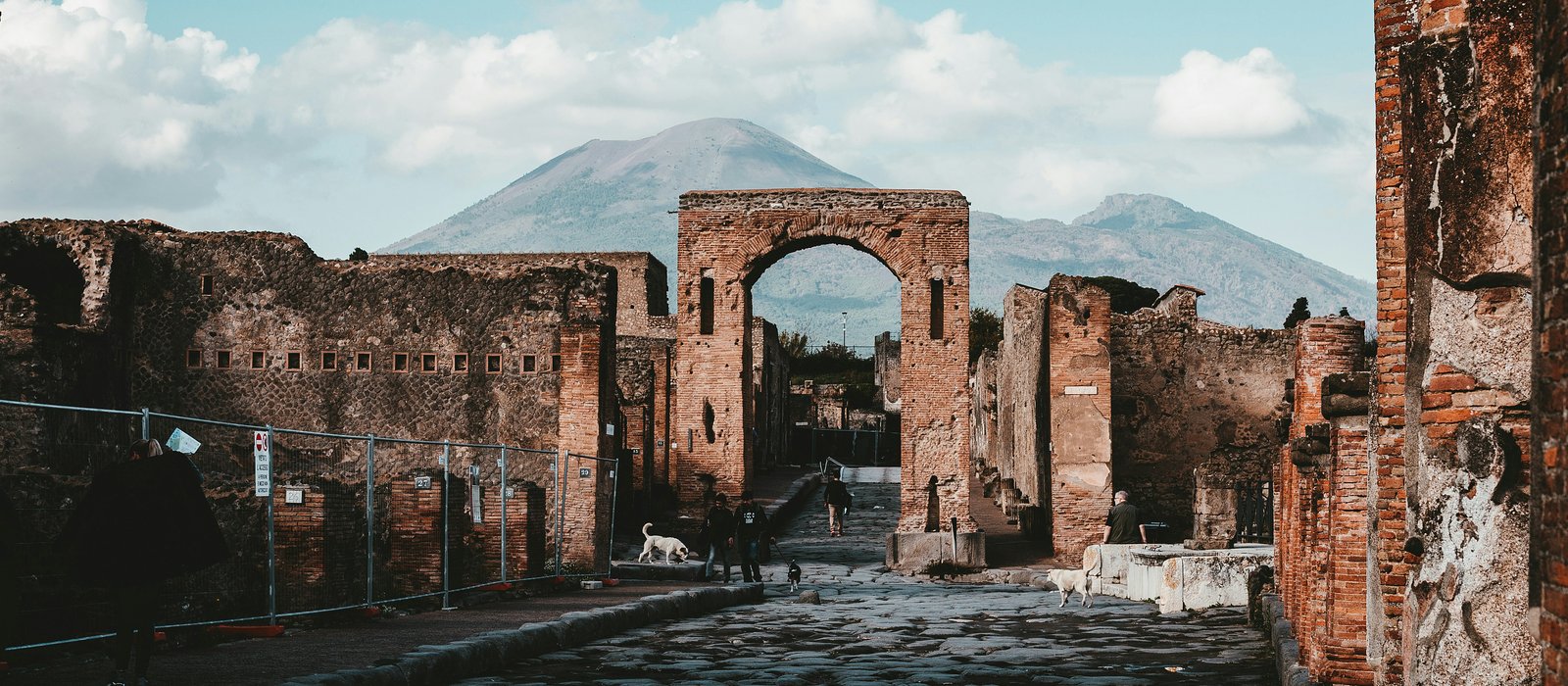
Of all the day trips from Rome, none delivers quite like Pompeii. Walking the stone streets of a Roman city stopped mid-life by Vesuvius in 79 AD — past bakeries, baths, frescoed houses, and the plaster casts of those who didn't escape — is one of the most affecting things you can do in Italy. And it's entirely possible as a day trip from Rome, if you plan the logistics well. This guide lays out exactly how to get there, how long it takes, and how to make a long day count.
Can you really do it in a day? Yes — but it's a full one
Be clear-eyed about this: Pompeii from Rome is a full day, roughly 12 hours door to door once you account for travel both ways and several hours at the site. That's not a reason to skip it — it's one of the most rewarding days you'll have — but it means an early start and realistic expectations. Don't try to pair it with anything else.
How to get there (the standard route)
The proven route has two legs:
- Rome to Naples by high-speed train. Trenitalia and Italo high-speed trains run from Roma Termini to Napoli Centrale in about 70 minutes, frequently, from early morning. This is the fast, comfortable part.
- Naples to Pompeii on the Circumvesuviana. From Naples, transfer to the local Circumvesuviana line toward Sorrento and ride about 35–40 minutes to the Pompei Scavi–Villa dei Misteri stop, which sits right at the ruins' Porta Marina entrance. The Circumvesuviana platforms are on the lower level of Napoli Centrale — follow the signs down.
All in, it's roughly two hours each way. The Circumvesuviana is a basic commuter line (no reservations, can be crowded, and air conditioning isn't guaranteed on every train), so build in a little buffer and keep an eye on your belongings.
Booking and timing tips
- Depart Rome early — aim for a train by 8:00–8:30 a.m. at the latest. The earlier you arrive at Pompeii, the more you see and the cooler it is.
- Pre-book your high-speed train, especially the return. The late-afternoon Rome-bound trains (the 5–7 p.m. window) fill up, and you don't want to be stranded after a long day.
- Buy your Pompeii entry ticket before you leave Rome. Don't gamble on buying at the gate after a two-hour journey — secure it in advance.
- The Circumvesuviana you just buy at the station — no advance booking needed or possible. Validate/tap your ticket as required to avoid a fine.
- Plan your last Circumvesuviana back to Naples so you make your high-speed return — the local trains stop running well before midnight, but you'll be heading back far earlier than that.
Guided tour vs. doing it yourself
This is the day trip where a guided tour makes the most sense for many travelers, and here's the honest trade-off:
A guided day tour typically handles the round-trip transport, skip-the-line entry, and — most valuably — an expert who turns what can look like "a lot of old walls" into a vivid, human story: which building was the bakery, what the graffiti says, how the casts were made. For a site as information-dense as Pompeii, that context is the difference between impressive and unforgettable. It also removes all the multi-leg transport planning above. The trade-off is cost and a fixed schedule.
Doing it independently is cheaper and more flexible, and entirely doable with the route above — just bring a good guidebook or audio guide, because unguided Pompeii can be bewildering. If you go independent, consider hiring a guide at the entrance or using an app to avoid wandering past the highlights without realizing it.
What to see at the site
Pompeii is large — you won't see all of it — so prioritize:
- The Forum, with Vesuvius looming behind it: the civic heart of the city.
- The Villa of the Mysteries, for its remarkably vivid frescoes.
- The House of the Faun and House of the Vettii, grand homes with mosaics and restored interiors.
- The amphitheater and the theater.
- The plaster casts of victims — sobering, unforgettable, and the detail that makes the catastrophe real.
Give yourself at least three hours on site; more if you're thorough. Wear real shoes (uneven ancient stone), bring water and sun protection — there's little shade — and a hat, especially in summer.
When to go and what to bring
Timing the season matters more at Pompeii than almost anywhere in Rome, because the site is large, open, and almost entirely unshaded. Summer midday on the ruins is genuinely punishing — if you're visiting July or August, the early start isn't just about crowds, it's about getting your walking done before the worst heat. Spring and fall are ideal. Whenever you go, the early train pays off twice: cooler stones and thinner crowds.
What to bring for the day:
- Real walking shoes — Pompeii's streets are original Roman paving: uneven, rutted with ancient cart tracks, and unforgiving in sandals.
- Water and sun protection — a refillable bottle (there are fountains on site), a hat, and sunscreen. Shade is scarce.
- A guide or app — independent visitors especially benefit from something that explains what they're looking at; the site's signage is limited.
- Cash for the Circumvesuviana — small amounts are handy for the local train and any station kiosks.
A note on combining with Naples
Many guided itineraries pair Pompeii with a quick taste of Naples (and its famous pizza) on the way through. That's a pleasant bonus if it's built into a tour, but don't try to engineer a thorough Naples visit onto an already-full Pompeii day yourself — there isn't time to do both justice. Treat Naples as a passing taste, not a second destination.
The bottom line
Pompeii in a day from Rome is a long but deeply rewarding outing: high-speed train to Naples (~70 min), Circumvesuviana to the ruins (~35–40 min), about two hours each way. Leave early, pre-book your trains and your Pompeii ticket, and seriously consider a guide to bring the ruins to life. Give the site at least three hours, wear good shoes, and don't stack anything else on the day. You'll come back to Rome tired — and having walked through the most extraordinary window into ancient daily life anywhere on earth.
Keep planning
Not sure how it all fits together?
Pick your trip length and we'll route a real day-by-day plan.
Build your trip →